Physics A Level | Chapter 2: Accelerated motion 2.8 The equations of motion
chevron_forward
visibility 492update 4 years agobookmarkshare
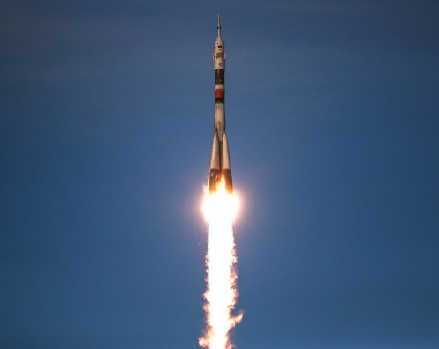
As a space rocket rises from the ground, its velocity steadily increases. It is accelerating (Figure 2.12).
Eventually, it will reach a speed of several kilometres per second. Any astronauts aboard find themselves pushed back into their seats while the rocket is accelerating.
Figure 2.12: A rocket accelerates as it lifts off from the ground
The engineers who planned the mission must be able to calculate how fast the rocket will be travelling and where it will be at any point in its journey. They have sophisticated computers to do this, using more elaborate versions of the four equations of motion.
There is a set of equations that allows us to calculate the quantities involved when an object is moving with a constant acceleration.
The quantities we are concerned with are:
s displacement
u initial velocity
v final velocity
a acceleration
t time taken
The four equations of motion are shown above.
Take care using the equations of motion. They can only be used for:
- motion in a straight line
- an object with constant acceleration.
KEY EQUATIONS
The four equations of motion:
equation 1: $v = u + at$
equation 2: $s = \frac{{(u + v)}}{2} \times t$
equation 3: $s = ut + \frac{1}{2}a{t^2}$
equation 4: ${v^2} = {u^2} + 2as$
To get a feel for how to use these equations, we will consider some worked examples. In each example, we will follow the same procedure:
Step 1: We write down the quantities that we know, and the quantity we want to find. Step 2: Then we choose the equation that links these quantities, and substitute in the values. Step 3: Finally, we calculate the unknown quantity.
We will look at where these equations come from in the next topic, ‘Deriving the equations of motion’.
WORKED EXAMPLES
4) The rocket shown in Figure 2.12 lifts off from rest with an acceleration of $20\,m\,{s^{ - 2}}$. Calculate its velocity after $50 s$. Step 1: What we know:
$\begin{array}{l}
u = 0\,m\,{s^{ - 1}}\\
a = 20\,m\,{s^{ - 2}}\\
t = 50s
\end{array}$
and what we want to know: $v = ?$ Step 2: The equation linking u, a, t and v is equation 1:
$v = u + at$
Substituting gives:
$v = 0 + (20 \times 50)$ Step 3: Calculation then gives:
$v = 1000\,m\,{s^{ - 1}}$
So the rocket will be travelling at $1000\,m\,{s^{ - 1}}$ after $50 s$. This makes sense, since its velocity increases by $20\,m\,{s^{ - 1}}$ every second, for $50 s$.
You could use the same equation to work out how long the rocket would take to reach a velocity of $2000\,m\,{s^{ - 1}}$, or the acceleration it must have to reach a speed of $1000\,m\,{s^{ - 1}}$ in $40 s$ and so on.
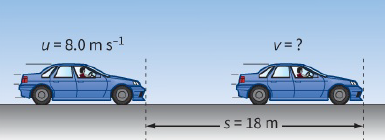
5) The car shown in Figure 2.13 is travelling along a straight road at $8.0\,m\,{s^{ - 1}}$. It accelerates at $1.0\,m\,{s^{ - 2}}$ for a distance of $18 m$. How fast is it then travelling?
Figure 2.13: For Worked example 5. This car accelerates for a short distance as it travels along the road
In this case, we will have to use a different equation, because we know the distance during which the car accelerates, not the time. Step 1: What we know:
$\begin{array}{l}
u = 8.0\,m\,{s^{ - 1}}\\
u = 8.0\,m\,{s^{ - 1}}\\
s = 18m\,
\end{array}$
and what we want to know: $v = ?$ Step 2: The equation we need is equation 4:
${v^2} = {u^2} + 2as$
Substituting gives:
${v^2} = {8.0^2} + (2 \times 1.0 \times 18)$ Step 3: Calculation then gives:
$\begin{array}{l}
{v^2} = 64 + 36 = 100\,{m^2}\,{s^{ - 2}}\\
v = 10\,m\,{s^{ - 1}}
\end{array}$
So the car will be travelling at $10\,m\,{s^{ - 1}}$ when it stops accelerating.
(You may find it easier to carry out these calculations without including the units of quantities when you substitute in the equation. However, including the units can help to ensure that you end up with the correct units for the final answer.)
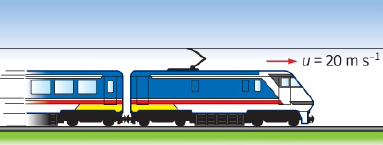
6) A train (Figure 2.14) travelling at $20\,m\,{s^{ - 1}}$ accelerates at $0.50\,m\,{s^{ - 2}}$ for $30 s$. Calculate the distance travelled by the train in this time.
Figure 2.14: For Worked example 6. This train accelerates for $30 s$
Step 1: What we know:
$\begin{array}{l}
u = 20\,m\,{s^{ - 1}}\\
t = 30s\\
a = 0.50\,m\,{s^{ - 2}}
\end{array}$
and what we want to know: $s = ?$ Step 2: The equation we need is equation 3:
$s = ut + \frac{1}{2}a{t^2}$
Substituting gives:
$s = (20 \times 30) + \frac{1}{2} \times 0.5 \times {(30)^2}$ Step 3: Calculation then gives:
$s = 600 + 225 = 825 m$
So the train will travel $825 m$ while it is accelerating.
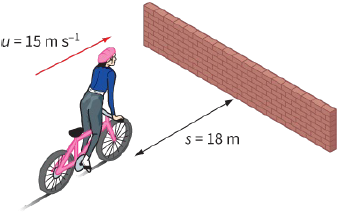
7) The cyclist in Figure 2.15 is travelling at $15\,m\,{s^{ - 1}}$. She brakes so that she doesn’t collide with the wall. Calculate the magnitude of her deceleration.
Figure 2.15: For Worked example 7. The cyclist brakes to stop herself colliding with the wall
This example shows that it is sometimes necessary to rearrange an equation, to make the unknown quantity its subject. It is easiest to do this before substituting in the values. Step 1: What we know:
$\begin{array}{l}
u = 15\,m\,{s^{ - 1}}\\
v = 0\,m\,{s^{ - 1}}\\
s = 18m
\end{array}$
and what we want to know: $a = ?$ Step 2: The equation we need is equation 4:
${v^2} = {u^2} + 2as$
Rearranging gives:
$\begin{array}{l}
a = \frac{{{v^2} - {u^2}}}{{2s}}\\
a = \frac{{{0^2} - {{15}^2}}}{{2 \times 18}}\\
= \frac{{ - 225}}{{36}}
\end{array}$ Step 3: Calculation then gives:
$a = - 6.25\,m\,s{\,^{ - 2}}\, \approx \, - 6.3\,m\,{s^{ - 2}}$
So the cyclist will have to brake hard to achieve a deceleration of magnitude $6.3\,m\,{s^{ - 2}}$. The minus sign shows that her acceleration is negative; in other words, a deceleration.
Questions
9) A car is initially stationary. It has a constant acceleration of $2.0\,m\,{s^{ - 2}}$.
a: Calculate the velocity of the car after $10 s$.
b: Calculate the distance travelled by the car at the end of $10 s$.
c: Calculate the time taken by the car to reach a velocity of $24\,m\,{s^{ - 1}}$.
10) A train accelerates steadily from $4.0\,m\,{s^{ - 1}}$ to $20\,m\,{s^{ - 1}}$ in $100 s$.
a: Calculate the acceleration of the train.
b: From its initial and final velocities, calculate the average velocity of the train.
c: Calculate the distance travelled by the train in this time of $100 s$.
11) A car is moving at $8.0\,m\,{s^{ - 1}}$. The driver makes it accelerate at $1.0\,m\,{s^{ - 2}}$ for a distance of $18 m$. What is the final velocity of the car?